A newly signed master research agreement with The Lighting Quotient will connect University expertise with advanced optical engineering and lighting-design innovation.
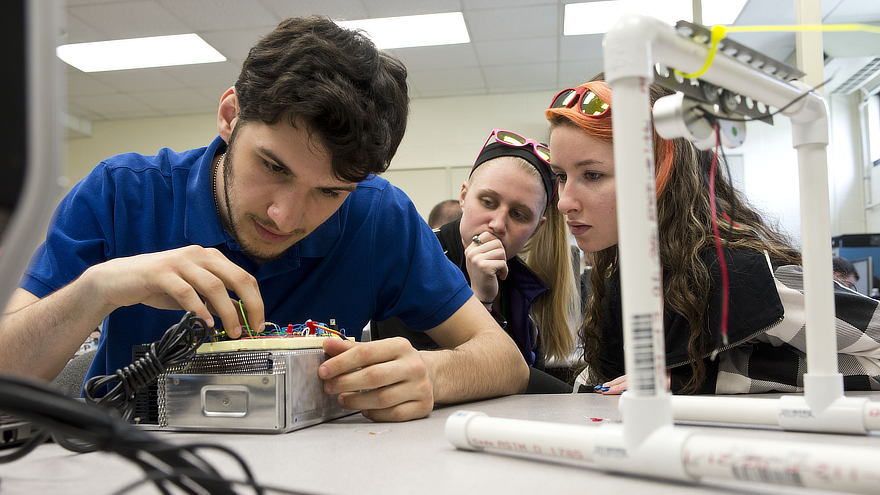
The University of New Haven has entered into a master research agreement with , a West Haven–based manufacturer known for its advanced lighting systems. The collaboration, led through the Elevation Center at the University of New Haven, will support applied research initiatives alongside creating opportunities for students to engage with engineering and product development challenges in the lighting industry.
Founded on a legacy that traces back to the pioneering lighting work of Sylvan R. Shemitz, The Lighting Quotient has built a reputation for blending engineering precision with architectural design. The company develops advanced luminaires used by architects, lighting designers, and facility planners across a wide range of environments, from office buildings and schools to museums, transportation hubs, and landmark architectural spaces.
The Lighting Quotient designs and manufactures high-performance luminaires through its established brands—elliptipar®, tambient®, and MEYER—each known for combining optical performance with clean architectural aesthetics. Its engineering teams specialize in proprietary reflector technologies and LED optical systems that deliver highly controlled, uniform illumination tailored to complex architectural environments.
This focus on precision engineering and innovative design makes the partnership a natural fit for the University’s applied-research model.
“The Lighting Quotient represents the kind of forward-thinking company we aim to collaborate with through the Elevation Center,� said , the University of New Haven’s vice president of innovation and applied technology. “Their work combines engineering, design, and advanced manufacturing to solve challenges in the built environment. By working together, we can connect our students and faculty with meaningful projects while helping companies such as The Lighting Quotient continue to innovate.�
'These partnerships connect companies with faculty expertise and student talent'
The company serves a broad professional community, including architects, lighting designers, and institutional clients seeking highly specialized lighting solutions for commercial and public environments. Its products support projects ranging from everyday workplaces to complex architectural installations where lighting performance, energy efficiency, and visual comfort are critical.
“The Lighting Quotient has a long-standing relationship with the University of New Haven,� said Allison Schieffelin, the chief executive officer at The Lighting Quotient. “Through this new partnership we will engage faculty and students in applied work, exploring advanced materials and manufacturing process technologies in the development of superior lighting instruments for diverse indoor and outdoor architectural environments. We have had great success over decades hiring engineering and business talent from the University of New Haven, and now we see huge potential in our deepening relationship to achieve enterprise level gains alongside the Elevation Center."
The master research agreement with The Lighting Quotient adds to a growing portfolio of collaborations led by the University’s Elevation Center. These partnerships connect companies with faculty expertise and student talent to address real industry challenges, while preparing graduates for careers in engineering, technology, and advanced manufacturing.
Through initiatives such as MRAs, the University of New Haven continues to strengthen ties with organizations across Connecticut, reinforcing its role as a hub for applied research, industry collaboration, and workforce development.
Contact
Get the highlights!
Stay up to date with our weekly e-newsletter, highlighting stories from around the University and media clips featuring our faculty experts.