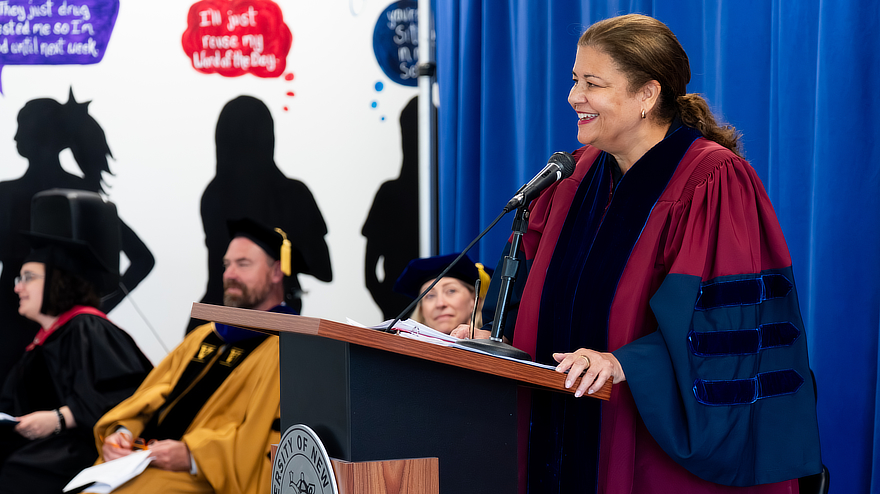
Celebrating their fourth commencement ceremony overall and the first held at the Federal Correctional Institution in Danbury, the University of New Haven Prison Education Program and Yale Prison Education Initiative recognized graduates whose educational journeys transformed their lives and communities.
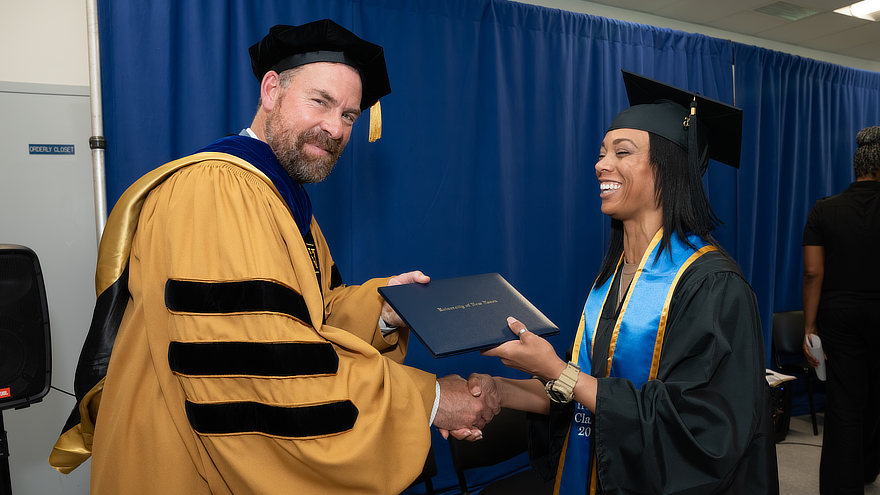
For the first time, graduates of the University of New Haven and the crossed the commencement stage at the Federal Correctional Institution in Danbury, marking a historic milestone for a program that continues to expand access to higher education behind prison walls.
The ceremony was the for the partnership between the University and YPEI, and the first held at Danbury, where the program for women began in 2022. Family members, faculty, University leaders, correctional staff, and supporters gathered to honor the achievements of the Class of 2026 and the transformative power of education.
"Today, we celebrate the achievements of our graduates and recognize their years of hard work, self-sacrifice, and, in particular, their incredible resilience and resolve," said , founding director of the University of New Haven Prison Education Program and the Yale Prison Education Initiative.
Warden Caryn Flowers reflected on the significance of the occasion, noting that the degree-granting program at Danbury is the only one currently operating in a federal women's prison in the United States.
"By investing in them here, we are investing in their futures, their families, and their communities on the outside," she said.
'You are showing what's possible'
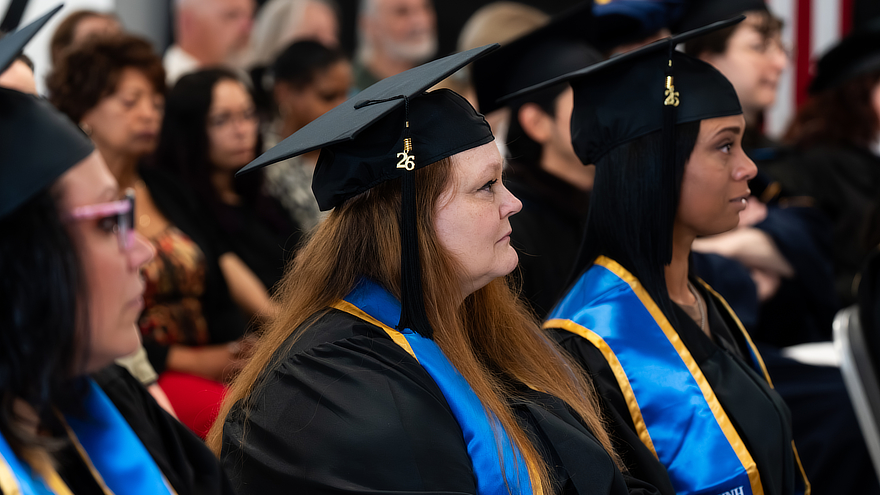
Throughout the ceremony, speakers emphasized how education creates opportunities for growth, leadership, and change.
Phil Bartels '11 Hon., a member of the University of New Haven , praised graduates for pursuing higher education under challenging circumstances.
"You stayed committed to learning, and to what comes next," he said. "You are showing what's possible."
University , described the commencement as both a celebration and a call to action. "You are leading by example, and you serve as an inspiration to countless others," he said.
President Frederiksen encouraged graduates to continue creating opportunities for others and reminded them that, "ideas and ideals are transcendent."
The graduates themselves offered powerful reflections on the impact education has had on their lives. Qua Black ’26 A.A. described discovering new strengths through courses in literature, writing, art, and mathematics.
"I am making and remaking myself and learning who I am through reading and rereading, writing and rewriting," she said. "I have learned the value of perseverance, the importance of intellectual curiosity, and the power of community."
She concluded with a message about the broader impact of educational opportunities in prison. "Education in prison changes lives,� she said. It creates artists, thinkers, students, mentors, humanitarians, and future leaders."
'It taught me to believe in myself again'
Several graduates reflected on overcoming doubt and embracing opportunities they once thought were beyond reach.
Jennifer Mae Camiolo ’26 A.A. recalled initially hesitating to apply to the program because she felt others deserved the opportunity more than she did. After not being selected for the first cohort, she decided to try again.
"I was disappointed, but I wasn't done," she said.
Camiolo described how studying subjects such as political science and mathematics expanded her understanding of the world and strengthened her confidence.
"Before this program, I had started to believe that certain opportunities were behind me," she said. "College didn't just teach me history or math or political science. It taught me to believe in myself again."
Karmen Englert ’26 A.A. spoke about how education helped her rediscover her identity. "They saw something in me that I didn't," she said of the program's faculty and staff. "They saw the part of me I lost long ago—the part of me that still dreamed."
Speaking of the faculty, she said they, “taught me perseverance, and they proved to me that I was resilient and that I was capable."
'The liberation of the mind'
The ceremony's Commencement address focused on the enduring power of education, reflection, and intellectual growth.
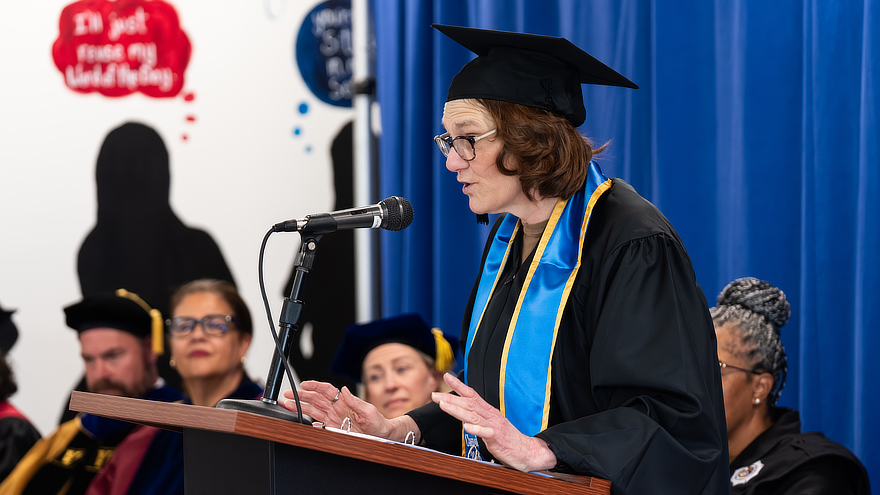
Drawing on writers, poets, and thinkers, speaker Elizabeth Alexander, Ph.D., president of the , emphasized that, “the liberation of the mind should be available everywhere and to everyone.� She encouraged graduates to recognize the significance of what they had accomplished together and the community they had built through learning.
At the conclusion of the ceremony, President Frederiksen formally conferred degrees and welcomed graduates into the University's alumni community.
Addressing the graduates, he reflected on the responsibility that accompanies education and the example they have set for future students.
"On behalf of all of our faculty and staff, we congratulate you, and we are proud to call you graduates of the University of New Haven," he said.
Contact
Get the highlights!
Stay up to date with our weekly e-newsletter, highlighting stories from around the University and media clips featuring our faculty experts.