In an opinion piece published in Puerto Rico’s most widely read newspaper, lecturer Yanice Mendez-Fernandez ’21 MPH called on officials to not forget the displaced and homeless populations impacted by COVID-19.
cares deeply about the intersection of healthcare and justice. From the very start of the , she was paying close attention – as an educator and as a student.
A native of Puerto Rico, Mendez-Fernandez, Ph.D., is a lecturer in the University of New Haven’s department of and , and she’s pursuing her in the .
As the pandemic spread, she was concerned about inequities in health care and about people who were already displaced or homeless in Puerto Rico from the earlier hurricanes and a recent series of earthquakes. She knew she had to share her voice, and share it quickly.
"With the public health training I have received so far at the University of New Haven, I felt prepared to advocate for the communities displaced by natural disasters."Yanice Mendez-Fernandez ’21 MPH
Dr. Mendez-Fernandez – who typically writes scientific papers and grants – wrote an op-ed in collaboration with , a network of professionals and students passionate about science and Puerto Rico. She sent it to – the newspaper with the highest circulation in Puerto Rico, and it was .
‘I hope I did my part’
Dr. Mendez-Fernandez says she felt compelled to share her voice.
"I moved to the continental U.S. in 1998, but my family and my heart remain on the island," she says. "The recent earthquakes have left people homeless, and many are still living in shelters or make-shift camps. These living conditions make them more vulnerable to the effects of the COVID-19 pandemic. With the public health training I have received so far at the University of New Haven, I felt prepared to advocate for the communities displaced by natural disasters."

She shared the piece with , an assistant professor of health administration and policy, the professor for her "Public Health Practice" course. Dr. Tran, a former journalist, encourages his students to become strong writers and communicators to get accurate health information out to the public across traditional media and social media platforms. He says it is critical that Dr. Mendez-Fernandez is speaking out for disenfranchised people during this pandemic.
In the piece, Dr. Mendez-Fernandez wrote, "The impact on emotional and mental health that people have suffered from experiencing these constant earthquakes can impact physical health, including the immune system. Thus, displaced persons may be at increased risk of contracting COVID-19, contributing to the establishment of clusters of infection."
She says she is proud to have written the piece. "My heart has been heavy for a long time," she says. "Though it may have been a very small contribution, I hope I did my part in trying to improve the health and well-being of Puerto Ricans."
‘I find myself thinking about those who are most vulnerable to the effects of this pandemic’
The public health crisis that followed Hurricane Maria in Puerto Rico was the catalyst for her to pursue her MPH. She wanted to study how natural disasters impacted infectious disease epidemics and mental health on the island.
"Because education is a determinant of health, I am also interested in learning how natural disasters have disrupted the education system and impacted Puerto Rican youth long term," she says.
This summer, she plans to collaborate with teachers in Puerto Rico to start collecting data on how the COVID-19 pandemic has affected communities displaced by recent earthquakes.
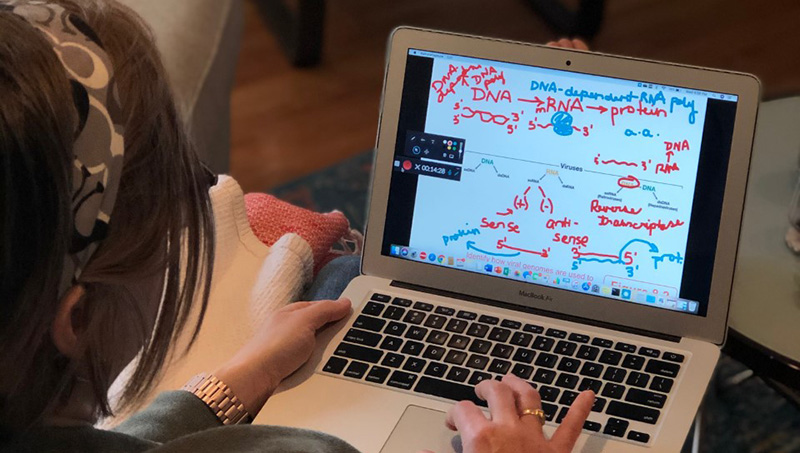
Meanwhile, in the immunology class she is teaching virtually at the University of New Haven, she is discussing how the coronavirus evades the immune system, and she assigned a project in which students design a vaccine for an infectious disease that currently does not have one. Some of the students have chosen to design a vaccine for COVID-19. "It will be interesting to see what they come up with," she says.
"I find myself thinking about those who are most vulnerable to the effects of this pandemic and what can be done to protect them."Yanice Mendez-Fernandez ’21 MPH
In her microbiology class, students are learning about viral replication, using coronaviruses as an example of viral replication cycles in RNA viruses. "The course also has a section on epidemiology, and we are looking at some basic concepts such as incidence, prevalence, and mode of transmission, using the current pandemic as an example," she says.
She says she is continually reflecting on what it means to be teaching immunology and microbiology while studying public health at this moment in time.
"This provides an incredible opportunity to evaluate in real time the effectiveness of different approaches to the pandemic and to reflect on our response as a country," she says. "Our health care system needs improvement, and this situation definitely highlights different areas we could be working on. Public health also deals with justice issues, and I find myself thinking about those who are most vulnerable to the effects of this pandemic and what can be done to protect them."
Help University of New Haven Students Charge Ahead
We've launched the Charge Ahead Student Support Fund in an effort to raise financial assistance for our students for such necessities as remote learning technology, food, housing, medical expenses, and other emergency needs. Please to make a contribution that will assist those in our University community who need our support.
Contact
Get the highlights!
Stay up to date with our weekly e-newsletter, highlighting stories from around the University and media clips featuring our faculty experts.